
Knowing the West Palm Beach scooter safety laws matters more every year because electric scooters have become a common sight along Clematis Street, Flagler Drive, and throughout downtown West Palm Beach. Commuters, tourists, and residents use them to cover short distances quickly and affordably.
But as their popularity has grown, so have the accidents. Electric-scooter collisions involving serious injuries and death have been reported in Palm Beach County.
At Bill Bone Law Group, we’ve represented victims of motor vehicle and micromobility accidents for over 25 years, helping them understand their rights and pursue compensation under Florida law.
You May Need This Article If:
- You or a loved one were injured in an e-scooter accident in West Palm Beach or Palm Beach County.
- You’re unsure whether you can sue after an e-scooter crash, whether you were the rider or a pedestrian struck by one.
- A family member was severely hurt or killed in a collision involving an e-scooter and a motor vehicle.
- You’ve been denied insurance benefits or are overwhelmed by the claims process after an e-scooter accident.
If you or someone you love has been injured in an electric scooter accident, you may be entitled to compensation under Florida law. The experienced attorneys at Bill Bone Law Group are ready to fight for your rights. Call us today for a free consultation.
What Are Florida’s Electric Scooter Laws?
Florida classifies electric scooters as “motorized scooters” under Florida Statutes § 316.003(48). The statute defines a motorized scooter as any motor-powered vehicle designed to travel on no more than three wheels and incapable of exceeding 20 miles per hour on level ground.
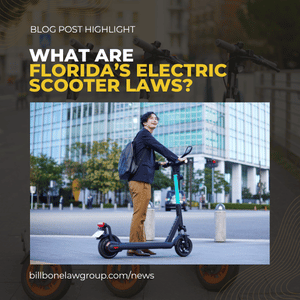 Under F.S. § 316.2128, e-scooter operators have the same rights and duties as bicycle riders under F.S. § 316.2065, except for bicycle-specific provisions that do not apply.
That means riders must obey traffic signals, ride with the flow of traffic, and follow the same rules of the road that apply to cyclists. The same statute states that no driver’s license, vehicle registration, or insurance is required to operate a qualifying motorized scooter or micromobility device in Florida.
Florida law does not impose a statewide minimum rider age; instead, local governments may adopt minimum-age requirements and may require operators to carry government-issued photo identification while riding.
The absence of insurance and licensing requirements may seem like a convenience, but it also means that e-scooter riders often lack the built-in protections that motorists enjoy. When an accident happens, questions about coverage and liability can become complicated quickly.
How E-Scooter Accidents Happen in Palm Beach County
Palm Beach County’s mix of busy roads and tourist foot traffic creates conditions where e-scooter accidents are increasingly common. Riders face uneven pavement, potholes, narrow bike lanes, and distracted drivers along routes like Southern Boulevard, Dixie Highway, and A1A.
Intersections on congested roads such as Okeechobee Boulevard present particular danger, as vehicles turning across bike lanes may fail to see a small, quiet scooter approaching.
The scenarios vary. A motorist may open a car door into a rider’s path along Clematis Street. A tourist unfamiliar with local traffic patterns may ride against the flow of traffic on Flagler Drive. An e-scooter’s brakes may fail on a rain-slicked stretch of road during an afternoon thunderstorm.
And because scooters offer virtually no physical protection, even low-speed crashes can result in serious injuries, including traumatic brain injuries, facial fractures, broken wrists, and spinal damage.
Local Rules: What’s Different in Palm Beach County
Florida law expressly allows local governments to adopt ordinances governing e-scooter use on streets, sidewalks, and highways within their jurisdictions. F.S. § 316.2128(1). Communities across Palm Beach County have taken varied approaches.
The City of West Palm Beach first approved Ordinance 4861-19 in 2019 to permit and regulate commercial micromobility systems, including e-bike and e-scooter rentals, with permit requirements for operators. The city later amended and restated those rules through Ordinance 4979-21.
Under the amended rules, motorized scooters, motorized bicycles, and bicycles may not be operated on public sidewalks. The city’s micromobility ordinance also provides that micromobility devices may not be operated by users under 16 years of age, and riders must stay out of pedestrian-only areas, yield to pedestrians, and follow the city’s operating restrictions.
 The Town of Palm Beach, by contrast, adopted a stricter package of ordinances on October 14, 2025. Ordinance 17-2025 prohibits micromobility devices, including e-bikes and motorized scooters, on any town sidewalk or multimodal trail.
Ordinance 16-2025 separately prohibits micromobility devices on the Lake Trail, subject to exceptions such as police, fire, public works, permitted vehicles, wheelchairs, and mobility devices for disabled persons. Ordinance 18-2025 establishes a minimum rider age of 15, requires riders under 16 to wear a properly fitted bicycle helmet, and requires operators to carry government-issued identification.
The regulatory picture continues to shift at the state level as well. During the 2026 session, the Florida Legislature passed CS/SB 382, a bill that would have added an electric-bicycle rule limiting e-bike operation to 10 miles per hour on sidewalks or other pedestrian-designated areas when a pedestrian was within 50 feet.
The bill also would have created a Micromobility Device Safety Task Force and required law-enforcement agencies to collect and report micromobility-device crash data. Governor DeSantis vetoed the measure on June 25, 2026, citing concerns that the speed rule could lead to surveillance and enforcement problems.
For now, the existing framework under F.S. § 316.2128 remains in effect, and riders should check the specific rules that apply in their city or town before heading out.
Where E-Bikes and Scooters Can Legally Operate
Growing e-scooter use across Palm Beach County has pushed cities to rethink where bikes and scooters belong on the map. As a starting point, state law sets the floor: F.S. § 316.2128 treats e-scooters like bicycles for purposes of the road, but it leaves the finer regulations —where riders may go, how fast they may travel, and what equipment they must carry—to local government.
That’s why a rider crossing from West Palm Beach into the Town of Palm Beach or another beachside community can find themselves suddenly bound by a very different set of rules.
In practice, this means e-scooters, e-bikes, and other motorized vehicles are typically welcome in bike lanes, bicycle lanes, and multi-use paths built for that purpose, but are barred from sidewalks reserved for walking, from limited access highways, and in the Town of Palm Beach; from the Lake Trail and other multimodal trails entirely.
Riders who are unsure whether a given street, trail, or waterfront path is open to motorized vehicles should check that city’s ordinance before setting out, since assuming the regulations are the same as the last town you rode through is one of the most common (and preventable) mistakes e-scooter riders make.
Ready to Speak With a Lawyer?
The electric scooter accident attorneys at Bill Bone Law Group have helped Florida injury victims seek justice and financial recovery for over three decades.
If you’ve been injured in an electric scooter accident in West Palm Beach or anywhere in Palm Beach County, contact us today for a free consultation and case review.
Understanding West Palm Beach scooter safety laws before you ride or pursue a claim can make all the difference, so call us today at (561) 264-5379.