
If you were injured due to marina liability and boat rental injuries in West Palm Beach, you need to know what your legal rights are. And fast.
Boating is part of life in Palm Beach County. Residents and visitors rent boats, use personal watercraft, board vessels at local marinas, and spend time on the water throughout West Palm Beach and the surrounding area.
Most outings end safely. But when a rental company provides an unsafe vessel, a marina fails to maintain its property, or an operator handles a boat carelessly, the result can be serious injury. At Bill Bone Law Group, we help injured people understand who may be responsible and what legal options may be available.
You May Need This Article If:
- You or a loved one was injured on a rented boat, Jet Ski, pontoon, or other vessel.
- A rental company failed to provide proper safety equipment, instructions, or warnings.
- You were hurt while boarding, exiting, or walking through a marina or dock area.
- You’re unsure whether the marina, rental company, boat operator, or another party may be legally responsible.
- A boating accident caused a serious injury or death in your family.
If you or someone you love was injured in a boat rental or marina-related accident, you may have rights under Florida law. Bill Bone Law Group helps injury victims and families evaluate these claims and deal with the insurers, businesses, and other parties involved.
What Is a Marina or Boat Rental Injury Claim?
A marina or boat rental injury claim usually depends on negligence. In practical terms, that means someone failed to use reasonable care, and that failure caused injury.
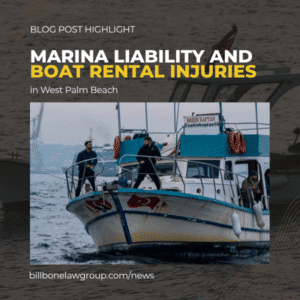 The responsible party may be the person operating the boat, the company that rented it, the marina that controlled the property, another boater, or more than one party at the same time. For example, a careless operator may be responsible for speeding, creating an unsafe wake, overloading the vessel, or failing to keep a proper lookout.
A rental company may be responsible if it rents out an unsafe vessel, skips required safety steps, or fails to provide required equipment. A marina may be responsible if an unsafe dock, walkway, ladder, lighting condition, or other property hazard causes injury.
Florida law also recognizes that vessels create serious risks. Under Florida Statutes § 327.32, vessels are considered “dangerous instrumentalities,” and vessel operators must exercise the highest degree of care to prevent injuries to others. The same statute contains limits on owner liability in some situations, so identifying the operator, owner, renter, and business involved is an important early step.
What Counts as a Marina or Boat Rental Injury?
Injuries at marinas and on waterways typically fall into three categories: operator errors, vessel defects, and marina premises hazards. Each one involves different parties and different legal theories.
Here’s what that looks like in practice:
- A boat driver ignores no wake zones and causes a collision
- A rental company rents out a boat with missing safety equipment or mechanical failures
- A marina fails to properly maintain its dock, causing a slip and fall
- An inexperienced operator on a personal watercraft — jet skis included — loses control and injures a passenger or other boaters
- A charter boat crew fails to keep a proper lookout, leading to a collision with other vessels
Recreational boating in South Florida is one of the most active in the country. According to the Florida Fish and Wildlife Conservation Commission (FWC), operator inexperience is a leading cause of accident fatalities in Florida. Palm Beach County consistently ranks among the most active boating counties in the state.
Marina Liability and Boat Rental Injuries in West Palm Beach — Who Can Be Held Liable?
When an accident happens on the water or at a dock, it’s not always just one person’s fault. Multiple people can be responsible at the same time. Figuring out who they are is the first step to getting compensated.
The Boat Operator
Under Florida law, boat operators must exercise reasonable care for the safety of passengers and others on the water. That includes maintaining a proper lookout, following speed limits, and respecting no-wake zones. When a boat operator fails to do that, they can be held personally liable for injuries sustained.
 Boat Owners
 Boat Owners
Boat owners can be liable even when they weren’t operating the vessel. If they loaned or rented a boat to someone who caused an accident, especially if that person was inexperienced or impaired. The owner may share responsibility. Florida law does not require boat owners to carry insurance to legally own or operate a boat, which can complicate the recovery process for accident victims when the liable party has no coverage.
Boat Rental Companies
This is where things get specific. Under Florida law, commercial boat rental operations carry substantial legal responsibilities. A rental company that rents a boat without required safety equipment, ignores mechanical issues, or fails to screen renters for basic competency can be held liable for resulting injuries.
Key facts about rental company obligations in Florida:
- Rental companies must carry liability insurance with minimum coverage of at least $500,000 per person and $1,000,000 per accident
- The Florida Boating Safety Act requires liveries to carry liability insurance covering bodily injury and property damage
- Boat rental injuries in West Palm Beach often result from operator inexperience, mechanical failures, and poorly maintained docks
Most rental companies require renters to sign a liability waiver. But here’s what matters: that waiver may not protect the rental company from liability, especially if it’s confusing, broadly written, or doesn’t cover the specific negligent act that caused the injury.
If a waiver is at issue in your case, our boat accident attorneys will analyze it.
Marinas
Under Florida premises liability law, commercial dock and marina operators owe the highest duty of care to customers classified as “invitees.” Marinas in West Palm Beach are routinely sued for slips and falls caused by water, fuel spills, algae, and loose mooring lines. Dock accidents are more common than people realize, and when a marina fails to maintain safe conditions, they face liability under both Florida statutes and federal maritime law.
Multiple Liable Parties
In many boating accident cases, more than one party contributed to what happened. A negligent boat driver, an unsafe rental boat, and a marina with unsafe conditions can all be part of the same accident. Florida law no longer holds all defendants jointly liable.
Each pays their proportionate share. That means identifying every negligent party matters directly to how much compensation you can recover.
In Florida, you must file a written accident report with the Fish and Wildlife Conservation Commission if a boating accident results in death, injuries needing medical care, or more than $2,000 in property damage.
How These Accidents Happen
Boat rental and marina injuries happen in many different ways. A renter may be given a vessel without meaningful instruction. A personal watercraft may be rented to someone who is too young or not legally qualified to operate it.
 A boat may lack properly available life jackets, working navigation equipment, a functioning engine cutoff switch, or other required safety equipment. A passenger may be thrown overboard because of a sudden turn, collision, excessive speed, or wake impact.
Marina injuries can be just as serious. Slippery walking surfaces, broken dock boards, poor lighting, missing handrails, damaged ladders, unsafe boarding areas, and inadequate warnings can all create risks for visitors.
These cases require close attention to who controlled the property, who knew or should have known about the hazard, and whether reasonable steps were taken to fix it or warn people.
Injuries Common in Marina and Boat Rental Accidents
Boating accidents can cause different injuries. Sme of them are permanent. The most common ones we see in maritime cases include:
- Traumatic brain injury from impact with the hull, dock, or water surface
- Spinal cord injuries that result in partial or full paralysis
- Broken bones from collisions, falls, or being struck by another vessel
- Oxygen deprivation / anoxic brain injury from near-drowning incidents. These can have effects that don’t fully appear until weeks after the accident occurred
- Emotional distress and psychological harm following a traumatic accident
- Wrongful death — when a family member is killed due to someone else’s negligence, surviving family members have legal options under Florida’s Wrongful Death Act
What Florida Requires From Boat Rental Businesses
Florida law uses the term “livery” for many commercial boat rental businesses. Under F.S. § 327.54, a livery generally includes a person or business that advertises and offers a livery vessel for use by another for consideration when that person does not also provide, or require the renter to provide, as a condition of the rental agreement, a person licensed by the U.S.
 Coast Guard to serve as master of the vessel or to manage the vessel. A livery may not offer vessels for rent without first obtaining a no-cost permit from the Florida Fish and Wildlife Conservation Commission, and the permit must be renewed each year.
The statute also creates safety duties that may matter in an injury claim. A livery may not knowingly rent a vessel that is overloaded, overpowered, missing required safety equipment, or not seaworthy.
The law defines “seaworthy” to mean that the vessel and its parts and equipment, including engines, bilge pumps, and kill switches, are functional and reasonably fit for their intended purpose.
Instruction is another key issue. Before allowing a rental vessel to be operated, Florida law requires the livery to provide pre-rental or pre-ride instruction covering the vessel’s operation, safe boating rules, right-of-way, the operator’s responsibility for safe operation, local waterway characteristics, emergency procedures, and other required safety topics. A signed form is important evidence, but it does not always answer whether meaningful instruction was actually given.
Can I File a Lawsuit?
Yes, if another person or business caused your injury through negligence or another legally recognized basis for liability. The claim may involve the boat operator, rental company, marina, property owner, maintenance contractor, or another responsible party.
Florida’s comparative fault law may affect the case. Under F.S. § 768.81, a party found more than 50% at fault for their own harm generally may not recover damages in a negligence action, except for the medical negligence exception stated in the statute. If the injured person is 50% or less at fault, recovery may be reduced by that person’s percentage of fault.
This makes evidence critical. Rental agreements, inspection records, instruction forms, photos, videos, witness names, employee statements, weather conditions, and accident reports can all affect how fault is assigned.
At Bill Bone Law Group, our boating accident lawyers will help you get the compensation you deserve.
What to Do After a Boat or Marina Accident
Seek medical care immediately. Boating injuries can involve head trauma, fractures, spinal injuries, propeller injuries, near-drowning complications, and internal injuries that may not be obvious at first.
 Report the accident when Florida law requires it. Under F.S. § 327.30, certain boating accidents must be reported without delay, including accidents involving death, disappearance under circumstances indicating possible death or injury, injury requiring treatment beyond immediate first aid, or apparent property damage of at least $2,000.
Preserve whatever you can. Keep the rental agreement, receipts, text messages, photos of the vessel, photos of the dock or marina area, witness contact information, and any paperwork showing what safety instructions were provided. If equipment was missing or defective, document it as soon as possible.
Finally, be aware of the filing deadline. Under F.S. § 95.11, negligence actions generally must be filed within 2 years of the accident. Wrongful death actions also generally have a 2-year deadline, but that deadline is based on the death, not simply the date of the boating accident.
What If the Accident Causes Death?
If a boating or marina accident results in death, Florida’s Wrongful Death Act may apply. Florida Statutes § 768.19 expressly covers deaths caused by wrongful acts, negligence, default, or breach of contract or warranty, including those occurring on navigable waters. A wrongful death action must be brought by the personal representative for the benefit of the survivors and the estate under F.S. § 768.20.
Ready to Speak With a Lawyer?
Bill Bone Law Group helps Florida injury victims and families understand their rights after serious accidents. If you were injured in a boat rental accident, hurt at a marina, or lost a loved one in a boating incident in West Palm Beach or Palm Beach County, contact us today for a free consultation and case review.
Contact us at 561-786-2641 for a free case evaluation for marina liability and boat rental injuries in West Palm Beach.