
A Florida motorcycle injury case involving helmet use is a negligence claim involving two overlapping questions:
- Did another driver (or another party) cause the crash?
- Did helmet use (or non-use) affect the severity of the rider’s injuries, and if so, how does that affect the amount of recoverable damages?
Florida’s helmet law is found in Florida Statutes § 316.211. The general rule is that no person may operate or ride on a motorcycle unless they are wearing approved protective headgear securely fastened to their head. F.S. § 316.211(1). Additionally, all riders must wear approved eye protection while riding on a motorcycle on public roads. F.S. § 316.211(2).
 But there is an important exception:
- Riders and passengers who are 21 or older may ride without a helmet if they are covered by an insurance policy providing at least $10,000 in medical benefits for injuries from a motorcycle crash. F.S. § 316.211(3)(b). This is known as the “helmet exemption.”
- Florida Department of Highway Safety and Motor Vehicles (“FLHSMV”) and rider-education materials describe this as a partial or optional helmet law: helmets are mandatory for riders under 21 but optional for riders 21 or older who meet the insurance requirement.
From a legal perspective, the fact that Florida law allows certain riders to go without a helmet does not mean helmet choices are irrelevant in a lawsuit. They can matter a great deal, just in a different way than many people assume.
Florida Motorcycle Helmet Law Issues in an Injury Case
Motorcycle injury cases in Florida often raise questions about helmet use. For motorcycle riders, the key issues are whether another driver caused the crash and whether helmet use—or non-use—affected the severity of injuries, which can influence a motorcycle accident claim.
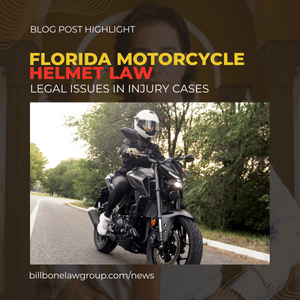
 Florida law (F.S. § 316.211) generally requires motorcycle operators and riders under 21 to wear helmets approved by the Department of Transportation. Riders and motorcycle passengers 21 or older may legally ride without a helmet if covered by an insurance policy providing at least $10,000 in medical benefits.
Even when helmet use is optional, it can affect an injury case. Helmets reduce the risk of head injury, traumatic brain injury, and severe head injury, which are common in serious crashes.
Protective gear is your last line of defense, especially when navigating high-risk routes for motorcyclists in West Palm, where congestion and distracted driving are most prevalent.
Defense attorneys may use the “helmet defense” to argue that some portion of injuries could have been avoided, particularly in cases involving motorcycle fatalities or motorcycle rider deaths.
Riders who were not wearing a helmet can still file a claim for medical bills, lost wages, and pain and suffering. To protect your rights, seek immediate medical care, preserve your helmet and gear, document the crash, and consult an experienced motorcycle attorney before speaking with insurers.
Understanding Florida’s helmet law and its role in a motorcycle injury case is crucial for protecting your rights and ensuring fair compensation while prioritizing rider safety.
How Helmet Issues Come Up After Crashes in Palm Beach County
Palm Beach County has formally adopted a Vision Zero Action Plan, built on the idea that traffic deaths and serious injuries are preventable, not inevitable.
The plan’s own data show that fatal and serious-injury crashes in the county disproportionately involve “vulnerable road users” – people walking, bicycling, or riding a motorcycle – because they have so little physical protection compared with someone in a car or truck.
 On the ground in West Palm Beach, that risk plays out on:
- High-speed roads like Okeechobee Boulevard, Southern Boulevard, and other multilane corridors
- Heavily traveled state and county roads connecting downtown, neighborhoods, and the I-95 corridor
- Intersections and turning movements, where a driver’s single missed glance can put a motorcyclist directly in harm’s way
Statewide FLHSMV crash reports confirm what riders already know: motorcycle crashes make up a small share of total collisions but a disproportionately high share of deaths and serious injuries.
Helmet use enters the picture in two main ways:
- Medical reality. Public-safety and injury-law sources consistently note that DOT-approved helmets reduce the risk of head and brain injuries, even in high-severity crashes.
- Legal strategy. After a crash, insurers and defense lawyers often look closely at whether the rider was wearing a helmet and whether that choice can be used as part of a “helmet defense” to reduce the injured rider’s compensation.
That’s why understanding Florida’s helmet law and how it interacts with negligence and damages is critical if you’re litigating a motorcycle case in Palm Beach County.
Can I File a Lawsuit in Florida If I Wasn’t Wearing a Helmet?
Short answer: Yes, you usually still can.
 Riding without a helmet does not automatically bar you from bringing a personal injury claim after a crash.
You can still pursue damages for:
- Medical bills
- Lost wages or earning capacity
- Pain and suffering
- Other economic and non-economic losses
The fight usually isn’t about whether you can sue; it’s about how much you can recover. That is, Florida courts don’t automatically punish a rider for choosing not to wear a helmet. But if the evidence shows that helmet use would have significantly changed the outcome of the injuries, that decision can become part of the comparative-fault analysis.
Florida’s modified comparative negligence rule and the “helmet defense”
Florida follows the doctrine of modified comparative negligence (or “comparative fault,” the term used under Florida law). F.S. § 768.81(6). If you’re 50% or less at fault, you recover damages reduced by your percentage, e.g., 30% fault on $10,000 damages = $7,000 recovery. If you’re more than 50% at fault, you are completely barred from recovery.
 Under the “helmet defense,” defense lawyers may argue that:
- You were lawfully on the road,
- The other driver caused the crash, but
- Your injuries were worse because you chose not to wear a helmet.
If they can convince a jury, often using medical or biomechanical testimony, that some portion of your head or brain injury would likely have been avoided with a helmet, the jury can assign a percentage of fault to your helmet choice and reduce your damages accordingly.
What to Do Next After a Helmet-Related Motorcycle Crash
Whether you were wearing a helmet or not, the steps you take right after a crash can affect both your health and your legal claim.
- Get medical care right away. Head, neck, and brain injuries don’t always show their full impact at the scene. Prompt evaluation and imaging help protect you medically and create a clear record of your injuries.
- Call law enforcement and make sure a crash report is created. The report isn’t the final word on fault, but it’s a key starting point for reconstructing what happened and identifying witnesses.
- Preserve your helmet and riding gear. If you were wearing a helmet, don’t throw it away, even if it looks ruined. Damage patterns can help experts explain how the impact occurred and support your damage claim. If you weren’t wearing a helmet, preserve whatever gear you did have (jacket, gloves, boots) for the same reason.
- Gather and keep any photos, videos, or medical records. Scene photos, surveillance footage, and hospital records often become crucial evidence, especially in cases where the defense argues about how your injuries occurred or how severe they are.
- Avoid giving detailed statements to insurers before you talk to a lawyer. Insurance adjusters may ask pointed questions about helmet use, prior injuries, or your decision to ride that day. Those statements can later be used to support a helmet-defense argument or minimize your damages.
- Talk with a West Palm Beach motorcycle accident lawyer who understands helmet-law issues. These cases require a firm understanding of comparative-fault laws, the helmet defense, and the local crash patterns in Palm Beach County.
Ready to Speak With a Lawyer?
 Bill Bone Law Group has helped thousands of Florida injury victims obtain justice and financial recovery, including many riders hurt on Palm Beach County roads.
If you or someone you love was injured in a motorcycle crash, with or without a helmet, we’re here to help. Call 561-225-2139 any time, day or night.
You do not lose your rights simply because Florida’s helmet law gave you a choice, or because an insurer is trying to use that choice against you.
An experienced attorney can help you understand how the law applies to your specific crash, preserve critical evidence, and push back against unfair use of the helmet defense. Free consultation for Florida motorcycle helmet law cases.