
Comparative negligence considers how much your own carelessness contributed to your injuries. Under Florida Statutes § 768.81, your legally recoverable damages are reduced by your percentage of fault. If you’re more than 50% responsible for your own harm, however, you are completely barred from any recovery.
The cutoff is greater than 50%, so an even division of responsibility still permits recovery of half your damages. The reduction affects medical expenses, lost income, and any pain-and-suffering damages you’re otherwise entitled to seek.
For a hypothetical West Palm Beach case, assume legally recoverable damages total $120,000 and a jury assigns the pedestrian 20% of the fault and the driver 80%.
The pedestrian’s recovery would be $96,000 before fees, costs, and applicable reimbursement claims. A finding that the pedestrian was more than 50% responsible would instead eliminate recovery against the driver.
In a lawsuit, the jury decides each party’s percentage of fault, and the court enters judgment based on those percentages. The table below shows how that same $120,000 pedestrian accident case plays out as the pedestrian’s share of fault rises, and how the result would have differed under Florida’s old rule.
How fault affects a $120,000 pedestrian accident claim in Florida
Pedestrian’s share of fault | Driver’s share of fault | Recovery under current law | Recovery under the pre-2023 pure rule |
|---|---|---|---|
0% | 100% | $120,000 | $120,000 |
20% | 80% | $96,000 | $96,000 |
50% | 50% | $60,000 | $60,000 |
51% | 49% | $0 | $58,800 |
70% | 30% | $0 | $36,000 |
Hypothetical figures shown before attorney fees, costs, and any reimbursement claims. Current-law results follow § 768.81(2) and (6); pre-2023 results follow the pure comparative negligence approach described by the Florida Senate.
Florida’s approach to shared liability has evolved twice. Until 1973, Florida followed the principle of “contributory negligence,” which barred a victim from receiving any compensation if they had, in any way, contributed to their own injury.
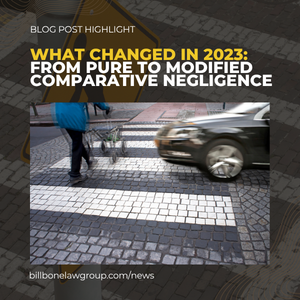 In the case of Hoffman v. Jones, the Florida Supreme Court replaced this rule with “pure comparative negligence.” Under this system, an individual who was 70% responsible for an injury valued at $100,000 could still recover $30,000 in damages.
In 2023, the Legislature replaced this system with “modified comparative negligence” through Chapter 2023-15, Laws of Florida. This legislation amended Section 768.81 to include a provision that bars any recovery if the victim’s share of responsibility exceeds 50%. With this change, Florida joined 23 other states that apply a similar rule.
The timeline is crucial. The modified comparative negligence rule applies to lawsuits filed after March 24, 2023, while the statute of limitations, now reduced to two years, applies to claims arising after that same date.
Many older articles still refer to the pure comparative negligence system; therefore, it is important to check the publication date of any material discussing liability law in Florida. There is, however, an exception: the 50% exclusion threshold does not apply to claims for personal injury or wrongful death resulting from medical negligence, which are governed by Chapter 766.
 Florida’s pedestrian rules don’t support the assumption that every mid-block crossing is illegal. F.S. § 316.130 generally requires pedestrians crossing outside a crosswalk to yield to vehicles. Between adjacent intersections with working traffic signals, pedestrians must use a marked crosswalk. They also cannot move into a vehicle’s path when it is too close for the driver to yield.
The crossing location deserves careful examination. Some intersections have unmarked crosswalks under F.S. § 316.003(17). Sidewalk connections can establish crossing boundaries without road paint, although not every intersection qualifies.
Determining whether you were within one of those crossings can change which right-of-way rule applied. The driver’s actions need examination, too.
Excessive speed, looking at a phone, or failing to brake for a pedestrian visible ahead may support a finding of negligence. Drivers still have a duty to use reasonable care even when someone crosses improperly.
That duty doesn’t make every collision the driver’s fault. If reasonable care would not have prevented the impact, the driver may not have been negligent. The investigation must account for the opportunity to see and respond to the pedestrian.
Can You Sue a Driver if You Were Jaywalking in Florida?
Yes. Florida law does not use the term “jaywalking,” and crossing outside designated crosswalks does not automatically invalidate a claim for an accident involving a pedestrian. Pedestrians are required to follow traffic laws, including obeying signs and traffic signals at intersections.
Disregarding traffic signals, such as crossing against a red light, can be detrimental to your case. Conversely, all drivers must exercise due care to avoid collisions with pedestrians and take necessary precautions when they see a child or an individual who appears disoriented or incapacitated.
Under Florida case law, violating a traffic regulation counts as prima facie evidence of negligence, but it does not automatically establish liability. The opposing party must still prove that the violation caused the harm.
This principle applies in both directions. Crossing in the middle of the street or walking while distracted may render you partially at fault, while driver negligence, such as distracted driving, speeding, or running a red light, can shift a percentage of the liability onto the other party.
Talk to a pedestrian accident lawyer to make sure you have all the legal options in your arsenal.
An allegation that you stepped into traffic suddenly should be tested against the timing, distances, and sight lines. Wearing dark clothing alone doesn’t establish that a driver couldn’t have avoided you.
Evidence of lighting, speed, and braking can help distinguish an unavoidable collision from one caused partly by inattention.
Useful evidence includes photographs of the crossing and obstructions, witness contact information, business surveillance footage, and dashcam recordings. Vehicle data may also help establish speed and braking. Ask about preserving recordings promptly because they can be overwritten.
An adjuster’s proposed fault percentage is open to dispute. It isn’t a court’s decision, and neither crossing improperly nor speeding automatically establishes a percentage of responsibility.
A citation may influence settlement discussions, but it doesn’t determine the outcome of your injury claim. F.S. § 316.650(9) generally keeps the citation itself out of trial evidence, with limited exceptions involving the citation document, such as forgery or perjury.
F.S. § 318.14(4)(b) also prevents the admission created by paying a civil traffic penalty from being used as evidence in another proceeding. The underlying conduct remains relevant. Witnesses may testify about what happened, and a traffic-law violation can be evidence of negligence if it contributed to your injury. Get legal advice before deciding how to handle the ticket.
Children and Allegations of Impairment
 The same standard of care doesn’t apply to every pedestrian. A child under six cannot be assigned negligence. For older children, age, intelligence, and experience inform the care they can reasonably be expected to use. The driver’s negligence must still be established.
Alcohol or drug allegations also require more than broad accusations. F.S. § 768.36 requires impaired normal faculties from alcohol or drugs, or a blood or breath alcohol level of at least 0.08%, together with more than 50% responsibility resulting from that condition, to bar recovery.
Drinking alone doesn’t establish the defense. Properly taken prescription medicines and recommended doses of over-the-counter medicines are excluded from the statute’s drug definition.
Who Else Might Share Fault for a Pedestrian Accident?
Fault is not always limited to you and the driver. In some accidents involving pedestrians, multiple parties may be held liable. Under Section 768.81(3), the court will enter a judgment against each liable party based on their individual percentage of fault; a defendant who wishes to assert that a nonparty is liable must plead and prove the fault of that nonparty.
When a public entity may be partially liable, for instance, due to the design or lighting of a road, additional steps are required.
In accordance with Section 768.28(6)(a), you must generally submit your claim in writing to the relevant entity within three years after the claim accrues, as well as to the Florida Department of Financial Services (unless the claim is against a municipality or a county). No legal action may be initiated until this notification process has been completed.
Don’t wait for a fault dispute to be resolved before obtaining medical care. Available Personal Injury Protection (“PIP”) coverage generally pays covered losses regardless of fault under F.S. § 627.736.
A pedestrian violation by itself doesn’t preclude coverage. Qualifying initial medical care must occur within 14 days of the crash to preserve PIP medical benefits.
For negligence claims against private drivers arising from crashes after March 24, 2023, F.S. § 95.11(5)(a) generally allows 2 years to file suit. Keep treatment records and insurance statements and have the deadlines affecting your particular claim reviewed promptly.
Pedestrian Crashes in Palm Beach County
 According to the Palm Beach County Sheriff’s Office, the county ranks fifth among Florida counties with a population of over 300,001 in terms of traffic accidents resulting in serious or fatal injuries to pedestrians and bicyclists.
In 2025, pedestrians and bicyclists in the county were involved in 1,817 collisions, which included 157 accidents resulting in serious injuries and 52 fatal accidents.
From July 28, 2026, to May 7, 2027, the Sheriff’s Office is conducting “High Visibility Enforcement” operations at specific intersections throughout central Palm Beach County. According to authorities, the primary goal of this initiative is public awareness; however, any violation may result in a warning or a citation.
If you receive a citation as a pedestrian during this period, it generally cannot be used as evidence at trial in a personal injury lawsuit, pursuant to Section 316.650(9) of the Florida Statutes.