
Construction work in Florida remains among the most dangerous occupations in the state, and when a third party’s negligence is involved, understanding third-party liability at Florida jobsites can mean the difference between limited workers’ comp benefits and the full compensation you deserve.
Construction work in Florida remains among the most dangerous occupations in the state. According to the Bureau of Labor Statistics, Florida recorded 284 fatal work injuries in 2024, and the construction sector accounted for 88 of those deaths.
Falls, slips, and trips alone caused 39 construction fatalities that year. In Palm Beach County, workers face these hazards daily on commercial developments, residential projects, and roadway construction sites along busy corridors like I-95 and Okeechobee Boulevard.
At Bill Bone Law Group, we have represented injured construction workers and their families in West Palm Beach and throughout Palm Beach County for over 25 years. We understand the complex legal landscape that determines whether you can pursue compensation beyond workers’ compensation benefits.
You May Need This Article If:
- You or a loved one was injured on a construction site in West Palm Beach or Palm Beach County, and workers’ compensation benefits don’t cover your full losses
- You’re unsure whether you can sue a general contractor, subcontractor, property owner, or equipment manufacturer after a jobsite accident
- A family member was killed or catastrophically hurt in a construction accident and you want to know if a wrongful death lawsuit is possible
- You’re dealing with insurance adjusters and workers’ comp carriers while trying to understand your legal options
If you or someone you love has been injured in a construction accident, you may be entitled to compensation beyond workers’ compensation under Florida law. The experienced attorneys at Bill Bone Law Group are ready to fight for your rights. Call us today at 561-786-7373 for a free consultation.
What Is Third-Party Liability at Florida Construction Jobsites
Florida’s workers’ compensation system operates on a fundamental trade-off. Under F.S. § 440.015, the system represents a mutual renunciation of common-law rights and defenses: injured workers receive guaranteed benefits without proving fault, while employers gain protection from most civil lawsuits. This immunity, however, is not unlimited. It extends only to those who have the statutory duty to secure workers’ compensation coverage.
 Understanding the key differences between a workers’ compensation claim and a personal injury claim is essential for any injured employee navigating this process. A workers’ compensation claim provides partial wage replacement and coverage for medical expenses, but it does not compensate for pain, suffering, or full lost wages the way a personal injury claim can.
Third-party liability arises when someone outside this compensation bargain causes or contributes to your injury. Under F.S. § 440.39, an injured worker may accept workers’ compensation benefits and still pursue a separate negligence action against a third-party tortfeasor.
This means you can potentially recover damages that workers’ compensation doesn’t provide, including compensation for pain and suffering.
The Florida Supreme Court addressed this principle directly in Conklin v. Cohen, holding that immunity tracks the duty to secure compensation – “no more and no less.”
A defendant does not gain immunity simply by being involved in a construction project. The critical question is whether that party had the statutory obligation to provide workers’ compensation coverage or otherwise falls within the employer’s umbrella of protection.
In some cases, vicarious liability may also apply — for example, when an employer engaged a subcontractor or maintenance company to perform work on the employer’s business premises and that party’s negligence contributed to the workplace injury.
How Construction Accidents Happen in Palm Beach County
Palm Beach County’s construction industry operates at a demanding pace. Commercial developments rise along the coastline, residential communities expand westward, and infrastructure projects keep pace with one of Florida’s fastest-growing regions. This activity creates constant exposure to serious hazards.
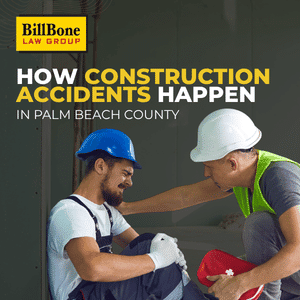 Falls remain the leading cause of death in construction. OSHA’s most recently published Top 10 Most Frequently Cited Standards lists fall protection violations as the number-one citation category nationwide. Official OSHA enforcement activity in South Florida has also included serious fall-hazard citations.
Violations of safety regulations are frequently a central factor in these accidents, and proving negligence often begins with documenting whether those standards were followed on the job site.
Equipment defects are another common source of serious injury on Palm Beach County job sites. When a tool, machine, or piece of safety equipment fails due to a manufacturing or design flaw, an injured employee may have a product liability claim in addition to — or separate from — their workers’ compensation claim.
When defective equipment causes a collapse, when a property owner’s negligence creates hidden dangers, or when a party outside the workers’ compensation immunity framework causes or contributes to an injury, the injured worker may have claims against parties beyond their direct employer. A general contractor, however, may have statutory-employer immunity under Florida law if workers’ compensation coverage was properly secured.
Can I File a Lawsuit in Florida?
Whether you can pursue a civil lawsuit depends on who caused your injury and whether they fall outside the workers’ compensation immunity framework.
Potential Third-Party Defendants
Property owners who are not your employer may be liable if their negligence contributed to your injury. Equipment manufacturers can face product liability claims if defective machinery caused the accident.
Engineering firms, architects, and safety consultants may bear responsibility if their professional failures created dangerous conditions. A maintenance company that was responsible for inspecting or servicing equipment on the job site may also be held liable if their failure to meet safety standards contributed to a job-related injury.
Drivers of vehicles that strike workers in construction zones represent another common category of third-party defendants.
Understanding Subcontractor Immunity
 Florida law provides specific protection for subcontractors working on the same project. Under F.S. § 440.10(1)(e), a subcontractor is protected by the exclusiveness-of-liability provisions against suit by an employee of another subcontractor or of the general contractor, but only if the subcontractor secured workers’ compensation coverage and only if its own gross negligence was not the major contributing cause of the injury.
A fellow employee generally cannot be sued individually for an on-the-job injury under Florida’s workers’ compensation framework, but this protection does not extend to parties who operate entirely outside the employment relationship.
Ordinary negligence alone is not enough to pierce this immunity.
Where gross negligence is alleged, courts require clear and convincing evidence that the conduct went substantially beyond ordinary carelessness — convincing evidence that the responsible party’s actions showed a conscious disregard for the safety of others.
Deadlines for Filing
Under F.S. § 95.11(5)(a), a negligence claim generally must be filed within two years of the date of injury, although deadlines can vary depending on the claim and defendant.
For wrongful death claims, the two-year period runs from the date of death, not the date of the accident. Missing these deadlines forfeits your right to sue, regardless of how strong your case might be.§ 95.11(5)(a)
What to Do After a Construction Accident
The steps you take immediately after an injury can significantly affect your ability to pursue third-party claims.
 Report the Injury and Seek Medical Care
 Report the Injury and Seek Medical Care
Document the incident with your employer and get medical attention promptly. Medical records establish both the extent of your injuries and their connection to the workplace accident.
Prompt medical treatment is critical not only for your recovery but also for establishing a clear record of your medical expenses and the full scope of your job-related injury.
Preserve Evidence
F.S. § 440.39(7) imposes a duty on employers and carriers to cooperate in investigating potential third-party claims. Florida courts have confirmed that this includes a duty to preserve evidence. Photograph the scene, collect witness contact information, and document equipment involved in the accident before conditions change.
If equipment defects may have played a role, preserving the physical evidence of those defects is especially important when it comes to proving negligence against a manufacturer or rental company.
Be Cautious with Statements
Insurance adjusters for third parties will contact you quickly. Their objective is to minimize liability. Avoid providing recorded statements or signing releases without legal guidance.
This is especially true in personal injury claims, where early statements can be used to challenge the severity of your injuries or your ability to file claims against multiple parties.
Consult an Attorney Before the Workers’ Comp Process Concludes
If you pursue a third-party claim while receiving workers’ compensation, your employer or carrier may assert a lien against any civil recovery for benefits already paid. An experienced attorney can help you navigate these overlapping claims and maximize your total recovery.
The goal is to ensure that you receive full compensation. Not just the partial wage replacement and limited medical benefits that Florida’s workers’ compensation law provides, but every dollar you are entitled to under the law.
Ready to Speak With a Lawyer?
Bill Bone Law Group has helped thousands of Florida injury victims seek justice and financial recovery. Construction accident cases involve technical legal questions about immunity, coverage obligations, and multiple potentially liable parties.
We have the experience to identify all available claims and fight for the compensation you deserve.
Contact us today for a free consultation and case review.
Call us now at 561-786-7373 our team is ready to help you understand your rights and pursue every avenue of third-party liability at Florida jobsites to secure the justice and compensation you deserve.