
Falls are the leading cause of fatal and non-fatal unintentional injuries among Florida residents ages 65 and older, highlighting the importance of proving fault in florida slip and fall cases.
According to the Florida Department of Health, 4,046 older adults were fatally injured in falls statewide in 2024.
Florida Department of Health county-level data show Palm Beach County recorded 350 deaths from unintentional falls in 2024, reflecting the risks residents face every day in grocery stores, shopping centers, restaurants, and public spaces throughout the region.
You May Need This Article If:
You or a loved one was injured in a slip and fall accident at a store, restaurant, or other business in West Palm Beach or Palm Beach County.
You’re unsure whether the property owner can be held responsible for your injuries.
A family member slipped on a wet floor, spilled liquid, or encountered another hazard and suffered broken bones, a head injury, or other serious harm.
You’re dealing with the property owner’s insurance company and aren’t sure of your legal options.
If you or someone you love has been injured in a slip and fall accident, you may be entitled to compensation under Florida law.
At Bill Bone Law Group, we’ve represented slip and fall victims in West Palm Beach and throughout Palm Beach County for over 25 years, helping injured individuals understand their rights and pursue the compensation they deserve.
Our experienced attorneys are ready to fight for your rights. Call us today at 561-264-5379 for a free consultation.
What Is a Slip and Fall Claim in Florida?
A slip-and-fall claim is a type of premises liability case in which an injured person seeks compensation from a property owner who failed to maintain safe conditions. These cases are often referred to as Florida slip-and-fall claims because they arise under state-specific premises liability laws.
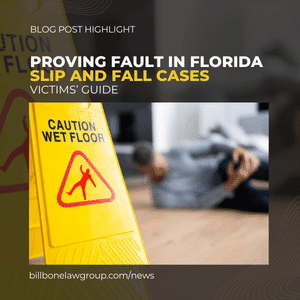 Under Florida law, a property owner becomes liable when the owner owed a duty of care to the injured person, breached that duty by failing to maintain safe premises or failing to warn of a dangerous condition, and that breach was the proximate cause of the victim’s injuries.
In many cases, working with a personal injury attorney can help injured victims understand their legal rights and options.
The scope of the duty depends on whether the injured person was an invitee (such as a customer in a store), a licensee (such as a social guest), or a trespasser. Business invitees receive the highest level of protection under Florida law.
For slip and fall accidents in business establishments involving transitory foreign substances – such as spilled liquids, dropped food, tracked-in rainwater, or debris – Florida Statutes § 768.0755 establishes the controlling legal standard.
This statute places the burden on the injured person to prove that the business had actual or constructive knowledge of the dangerous condition and should have taken action to remedy it.
This process is often referred to as proving negligence, which requires evidence showing the property owner knew or should have known about the hazard.
Many victims pursue compensation for medical expenses, lost income, and pain and suffering resulting from slip and fall injuries, which can range from minor sprains to severe fractures or traumatic brain injuries.
How Slip and Falls Happen in Palm Beach County
Palm Beach County’s busy retail centers, restaurants, hotels, and public spaces create countless opportunities for dangerous conditions to develop.
 Afternoon thunderstorms, common throughout the summer months, can leave entryways slick with tracked-in rainwater. Proper maintenance requires property owners to take reasonable steps to inspect and address hazards before visitors are injured.
Grocery stores along Okeechobee Boulevard and Congress Avenue see produce dropped in aisles. Restaurants in Rosemary Square and along Clematis Street may have grease spills near kitchens.
Hotels and condominiums throughout the region face ongoing challenges with pool deck maintenance and lobby floor care. After a fall occurs, documenting the accident scene with photographs and witness information can be critical to preserving evidence.
Common hazards that lead to slip and fall claims include wet floors from spills or mopping, loose floor mats or rugs, uneven surfaces or broken tiles, poor lighting that obscures hazards, debris or obstacles in walkways, and recently waxed floors without adequate warning signs.
When a property owner fails to address these conditions or warn visitors of their presence, serious injuries can result. Consulting a qualified slip and fall attorney can help injured individuals understand their legal rights and options after an accident.
The Knowledge Requirement
The knowledge requirement under F.S. § 768.0755 is often the most challenging element for slip and fall plaintiffs to establish.
 Insurance companies and defense attorneys frequently argue that the business had no notice of the hazard before the accident. To succeed, you must prove the property owner had actual or constructive knowledge of the dangerous condition.
Actual knowledge means the property owner or an employee was directly aware of the specific hazard. Evidence of actual knowledge might include an employee witnessing the spill, a customer reporting the hazard to staff before the fall, a written incident report, or surveillance video showing an employee walking past the substance without addressing it.
Constructive knowledge can be proven through circumstantial evidence showing one of two things:
- (1) the dangerous condition existed for such a length of time that, in the exercise of ordinary care, the business should have known of the condition, or
- (2) the condition occurred with regularity and was therefore foreseeable. Most successful slip and fall claims rely on constructive knowledge because direct proof of actual knowledge is rarely available.
Evidence That Helps Prove Fault
Photographs and video taken immediately after the fall provide the strongest foundation for any premises liability claim.
Images should capture the hazard itself, the surrounding area, the exact location within the premises, lighting conditions, and any indicators suggesting the hazard was present for an extended period, such as dirty or discolored liquid, footprints tracked through the substance, or dried edges around a spill.
This type of documentation can play a critical role in helping an injured person pursue fair compensation for their damages.
 Surveillance footage is often the most compelling evidence in slip and fall cases. Security cameras can reveal how long the hazardous condition existed before the fall occurred, whether employees walked past the area without addressing the hazard, and whether routine inspections were conducted.
Because businesses typically overwrite surveillance footage within days or weeks, requesting preservation of this evidence immediately after a fall is critical. An experienced personal injury lawyer can send a preservation letter to prevent important evidence from being destroyed and to protect a potential slip and fall lawsuit.
Maintenance and inspection logs can reveal whether the business followed its own safety protocols. If the business cannot produce inspection logs for the relevant time period, or if the logs reveal inadequate inspection frequency, this evidence may support an inference that the business would have discovered the hazard had it been exercising reasonable care.
A pattern of similar incidents at the same location strongly supports an argument that the condition occurred with regularity and was therefore foreseeable.
Evidence showing the financial impact of the injury, including medical bills and lost wages, can further demonstrate the extent of damages suffered by the injured person.
An experienced attorney can evaluate evidence, including medical records and witness statements, to determine liability and damages.
Defense Property Owners May Raise
Property owners frequently assert that the dangerous condition was “open and obvious” and that the injured person should have seen and avoided it. This argument is commonly raised in fall negligence claims and other personal injury cases involving premises liability.
Under Florida law, when a danger is so apparent that a reasonable person exercising ordinary care would perceive and avoid it, the property owner’s duty to warn may be discharged. However, this defense has important limitations.
 Documentation such as medical records, photographs, and witness statements can help demonstrate the circumstances surrounding the fall incident and may counter claims that the hazard was obvious.
The open and obvious doctrine typically affects only the duty to warn, not the duty to maintain the premises in a reasonably safe condition.
Florida courts have recognized that even when a hazard is visible, a property owner may still be liable for failing to correct a dangerous condition that poses an unreasonable risk of harm. Consulting a fall accident attorney can help injured individuals understand whether this defense may apply to their situation.
The doctrine may not apply if the property owner should anticipate that invitees will encounter the hazard despite its obvious nature – for example, if distracting circumstances such as merchandise displays, poor lighting, or crowds make it likely that visitors will not perceive the danger.
Even where the open and obvious doctrine applies, Florida’s comparative negligence system means that a plaintiff who fails to notice an obvious hazard may be found partially at fault but not necessarily barred from recovery entirely.
Proving fault in a slip and fall case can be complex, especially when property owners and insurance companies dispute liability.
Bill Bone Law Group has more than 25 years of experience representing injury victims in West Palm Beach and throughout Palm Beach County, and our attorneys know how to investigate accidents, gather critical evidence, and pursue maximum compensation for our clients. Pasted text
Call us today at 561-264-5379 or visit https://billbonelawgroup.com/ to schedule your free consultation. NO FEES unless we win your case.
Florida’s Modified Comparative Negligence Rule
Florida follows a modified comparative negligence system under F.S. § 768.81. Under this system, fault can be apportioned among all parties, including the plaintiff, the defendant property owner, and any other responsible parties.
 This modified comparative negligence standard directly affects whether an injured person can recover damages.
Your compensation is reduced in proportion to your percentage of fault. If you are found to be more than 50% at fault for causing the accident, you are completely barred from recovering any damages.
This rule makes fault determination a critical issue in every slip and fall case. Defense attorneys routinely argue that the plaintiff contributed to the accident by failing to watch where they were walking, wearing inappropriate footwear, being distracted by a phone, or ignoring posted warning signs.
Every aspect of your conduct before and during the fall is subject to scrutiny. An experienced legal team can help gather evidence to counter these arguments and strengthen your claim.
Because fault allocation can determine whether you receive compensation at all, it is essential to prove liability through documentation, witness testimony, and expert analysis whenever necessary.
Can I File a Lawsuit in Florida?
Yes. Under F.S. § 95.11(5)(a), you have two years from the date of a slip and fall accident to file a personal injury lawsuit. If you fail to file suit within this period, your claim will be permanently barred regardless of its merits or the severity of your injuries.
If your slip and fall occurred on property owned or controlled by a city, county, or state agency, Florida’s limited waiver of sovereign immunity imposes additional pre-suit requirements and caps on damages.
Claims against government entities are generally capped at $200,000 per person and $300,000 per incident, and specific notice requirements must be satisfied before suit may be filed.
What to Do Next
If you are injured in a slip and fall accident, take these steps to protect your health and your legal rights. Report the accident immediately to the property owner, manager, or employee and ensure they document it in an incident report.
 Request a copy of the report if possible. Seek medical attention promptly, even if your injuries seem minor, because some injuries may not manifest symptoms immediately, and prompt medical evaluation creates a record linking your injuries to the accident.
Document the scene thoroughly by taking photographs and videos of the exact location where you fell, the hazardous condition that caused your fall, your injuries, and the surrounding area, including any warning signs or the absence of them, lighting conditions, and nearby surveillance cameras. Collect names and contact information from anyone who witnessed your fall or observed the hazardous condition.
Request that the property owner preserve any surveillance footage in writing. Many business video systems record over footage every few days. Your attorney can follow up with a formal preservation demand.
Avoid giving recorded statements to the property owner’s insurance company without first consulting an attorney; insurance adjusters are trained to ask questions designed to minimize your claim or establish your own fault.
Ready to Speak With a Lawyer?
Bill Bone Law Group has helped thousands of Florida injury victims seek justice and financial recovery. If you’ve been injured in a slip and fall accident in West Palm Beach or anywhere in Palm Beach County, contact us today for a free consultation and case review. Don’t wait until deadlines pass or evidence disappears.
If you were hurt on someone else’s property due to a dangerous condition, you may have the right to recover compensation for your medical expenses, lost income, and other damages. Our team can guide you through the legal process and explain what steps are involved in building a strong claim.
Slip and fall cases often involve Florida proving negligence standards that require showing the property owner’s failure to maintain reasonably safe conditions or warn about hazards. Our slip and fall accident lawyer can evaluate your case, preserve critical evidence, and help you pursue the financial recovery you deserve.
Call us now at 561-264-5379 to protect your rights. Get a fair outcome in proving fault in Florida slip and fall cases.
To learn more, visit our Premises Liability Practice Area page.
Frequently Asked Questions
How long do I have to file a slip-and-fall lawsuit in Florida?
For most accidents occurring after March 2023, the statute of limitations is 2 years from the date of the fall. It is vital to act quickly because evidence like surveillance footage is often erased within 7 to 30 days, and the 2-year window can close faster than many victims realize while they are focused on recovery.
Does the business have to pay my medical bills immediately?
No. Unlike “no-fault” car insurance (PIP), property owners and their insurance companies are not required to pay your bills as they come in. They generally only pay a lump sum at the end of a settlement or after a successful trial verdict.
Victims usually have to use their own health insurance or work with providers who accept “letters of protection” from their attorney until the case is resolved.
What if there were a “Wet Floor” sign? Can I still sue?
Yes, potentially. A warning sign does not automatically absolve a property owner of all liability. While a sign helps their defense, you can still win if you prove the sign was poorly placed, the hazard was present for an unreasonable amount of time, or the owner failed to actually fix the underlying issue (like a recurring leak) that made the sign necessary in the first place.
Can you still recover damages if you were partially at fault?
Yes. Florida follows a modified comparative negligence rule, meaning your compensation is reduced by your percentage of fault. However, you cannot recover damages if you are more than 50% responsible.
What evidence is most important in a slip and fall claim?
Key evidence includes photographs of the hazard, surveillance video, incident reports, medical records, witness statements, and inspection or maintenance logs showing how long the condition existed.